For years, the aerospace industry watched Relativity Space with a mix of awe and skepticism. Founded in 2015 by Tim Ellis and Jordan Noone, the startup’s initial pitch sounded like pure science fiction: we are going to 3D print an entire rocket from scratch, with zero human labor. It was an idealistic, almost dogmatic vision. And for a while, it worked. It attracted venture capital, allowed them to build the world’s largest metal 3D printers, and culminated in the historic March 2023 launch of their debut rocket, the Terran 1.
But the aerospace market is unforgiving, and idealism might not survive contact with commercial reality. In a massive architectural and philosophical pivot over the last two years, Relativity has retired the Terran 1, completely overhauled its manufacturing strategy, changed its executive leadership, and placed all its chips on the massive, next-generation Terran R.
Relativity Space is no longer a 3D printing company trying to build a rocket. They are a launch company that happens to use 3D printing. Here is how the company, in Tim Ellis’ words, “started to grow up”.
The Terran 1 Experiment: Success, Then Retirement
First, we look back at the maiden flight of Terran 1. By most metrics, the March 2023 launch from Cape Canaveral was a monumental engineering success. The 34-meter rocket – 85% by mass 3D printed – successfully endured the extreme aerodynamic stresses of Max-Q. It proved, definitively, that a fully 3D-printed airframe could survive the brutal forces of orbital launch.
However, a second-stage ignition failure (caused by the ingestion of a gas bubble into the turbopump and a slow valve) prevented the rocket from reaching orbit. Relativity actually had a second Terran 1 rocket already built and nearly ready to fly to prove they could reach orbit. But instead of launching it, they made a shocking decision: they scrapped the Terran 1 program entirely.
Why? Because they listened to the market.
While Terran 1 proved the technology, the rocket’s 1-ton payload capacity belonged to a market segment that they considered to be rapidly losing relevance, with satellite operators no longer wanting small, expensive rides to space. Driven by the rise of massive telecommunications constellations, the market was, and still is, experiencing a severe shortage of medium-to-heavy lift, reusable rockets.
“We really just listened to customers,” Tim Ellis explained in an interview regarding the transition. “Terran R is really the only rocket that solves their core problem.” Rather than spending resources to get a fundamentally limited product to orbit just for the PR victory, Relativity chose to focus 100% of its workforce on the rocket their market actually wanted.
Breaking the Dogma: A Pragmatic New Approach
This pivot to the heavy-lift Terran R required Relativity to confront its own foundational strategy.
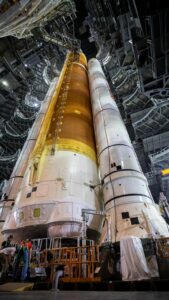
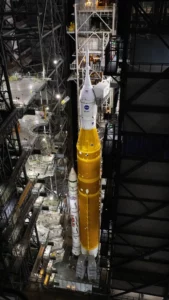
Originally, the goal was to 3D print as close to 100% of the vehicle as physically possible. But the Terran R is much larger. Standing roughly 284 feet tall with nearly 3.5 million pounds of thrust capacity, building a single Terran R requires vastly more printed material than a Terran 1. Trying to 3D print the massive, straight barrel sections of the rocket’s fuselage was slowing down production without adding significant engineering value.
“We started to grow up a bit,” Ellis admitted, noting that they needed to be “a little less pathological” about forcing 3D printing where it didn’t make sense. Instead of treating 3D printing as an end goal, Relativity began using it strategically as a tool for extreme rapid iteration. They focused their printing technology on the most complex, high-value components – like the new 269,000-pound thrust Aeon R engines and complex internal structures.
Capturing the Value: Why Build Their Own Printers?
During the company’s early years, many industry observers wondered why Relativity was spending so much capital developing its massive Stargate 3D printers from scratch instead of buying existing commercial machines – or alternatively, why they didn’t just sell the printers they invented.
For Ellis, the answer came down to a fundamental flaw in the 3D printing industry’s business model. “Everybody builds printers and tries to sell printers, and it’s a terrible business model”. He points out that printer manufacturers face massive adoption friction because they have to convince legacy companies to completely redesign their products from scratch to actually see any benefits. Furthermore, the manufacturer only captures a fraction of the value from the one-time sale of a machine. The real financial value would lie in being the end user. While a printer manufacturer might make a small profit selling a machine, a company like Relativity uses that machine to save hundreds of thousands of dollars a month by consolidating parts and accelerating engine production. By acting as a vertically integrated end user, Relativity never had to wait for legacy aerospace to adopt 3D printing. They designed the rocket for the printer from day one, allowing them to capture all the cost-saving value themselves. Even as they scaled back on printing the primary structure of Terran R, this philosophy remains the driving force behind their rapid, in-house production of the highly complex Aeon R engines.
The 2025 Reality Check: Eric Schmidt and the End of “Print Everything”
If pivoting away from Terran 1 was them “growing up,” the events of early 2025 were them entering full corporate adulthood.
Facing the immense capital requirements needed to bring a heavy-lift rocket to the pad, Relativity secured a massive financial lifeline. Former Google CEO Eric Schmidt purchased a controlling stake in the company, injecting hundreds of millions of dollars and stepping in as the new CEO. Tim Ellis transitioned to a Co-founder and Board member role, praising Schmidt’s tenacity to propel the dream forward.
Under Schmidt’s leadership, the company made its most pragmatic decision yet: they officially dropped the idea of 3D printing the Terran R’s primary structure.
To ensure Terran R gets to market fast, Relativity adopted a hybrid manufacturing approach. The primary structures and tanks are now built using more traditional rolling and friction stir welding techniques, while the complex Aeon R engines continue to rely on advanced additive manufacturing.
Furthermore, they abandoned the idea of attempting full reusability right out of the gate. Relativity announced an iterative “Block” development plan: Block 1 will function purely as an engineering stepping stone to reach orbit, start delivering payloads, and execute recoveries to collect data from the flown stages. The results from Block 1 will allow them to make the needed changes to achieve operational reusability in Block 2, which will provide the operational experience to guide the changes to enable high-energy and high-cadence flights (targeting 50 to 100 a year) for Block 3.
What Exactly Is Left to 3D Print?
With the shift to a hybrid manufacturing model, the dream of a nearly 100% 3D-printed rocket is officially over. But additive manufacturing still plays a massive, mission-critical role in the vehicle.
Relativity stripped 3D printing away from the simple, massive structural components (like the main fuselage, domes, and straight barrel propellant tanks) where it was acting as a production bottleneck. Instead, almost all of the remaining 3D printing is dedicated to Terran R’s propulsion systems.
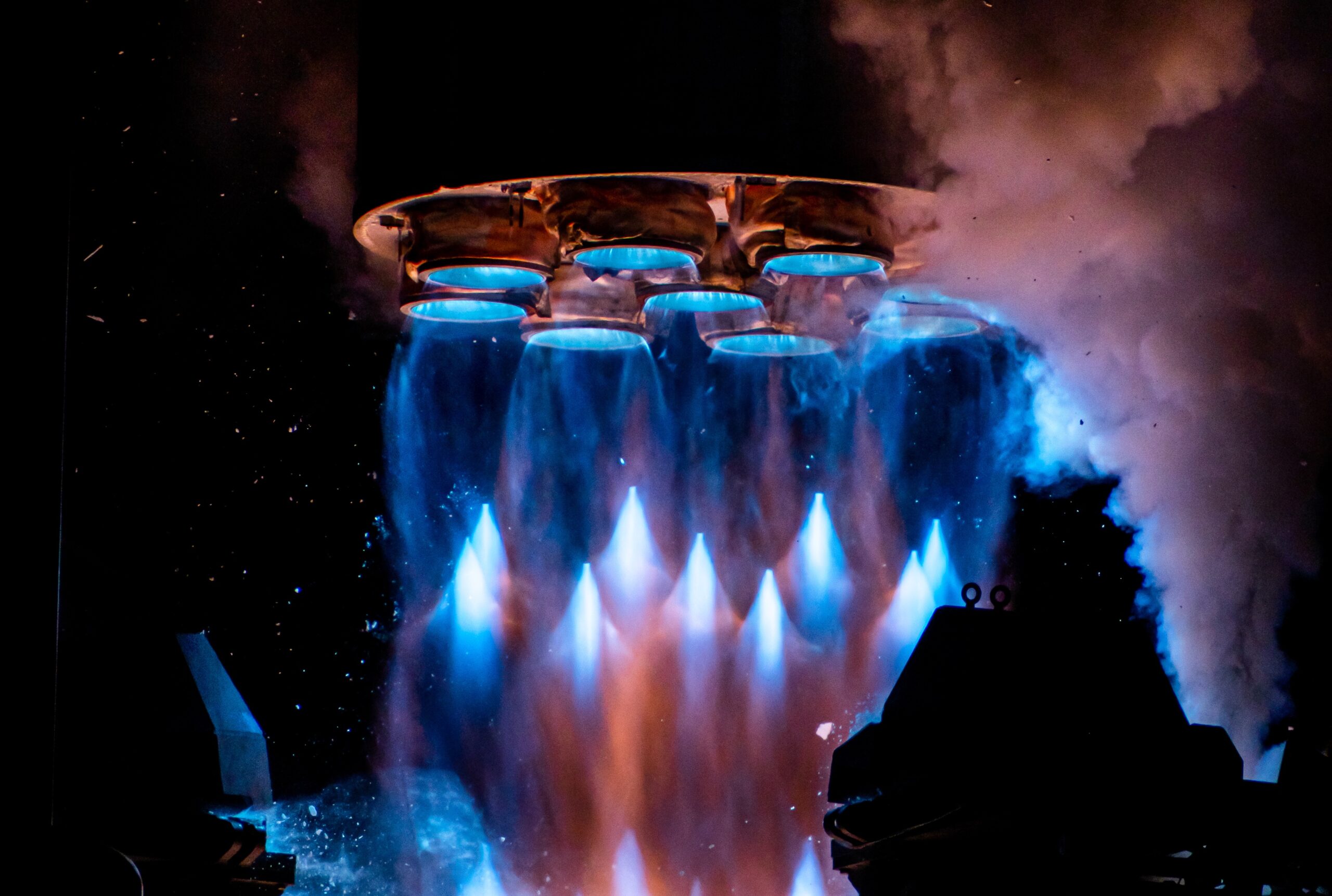
The 13 Aeon R engines on the first stage and the single Aeon V vacuum engine on the second stage are heavily additively manufactured using advanced techniques like Powder Bed Fusion (PBF) and Wire Arc Additive Manufacturing (WAAM). Because rocket engines are the most complex, part-dense components of a launch vehicle, 3D printing provides unparalleled economic and engineering value here. It allows Relativity to consolidate thousands of individual parts, such as the incredibly intricate regenerative cooling channels, into single components, drastically reducing assembly time, weight, and potential leak points while enabling ultra-fast design iteration.
Reverting to Reliable Pressurization
In another strike against ideological dogma, Relativity abandoned the cutting-edge autogenous pressurization used on Terran 1 and returned to traditional helium for Terran R.
The reason is purely practical and tied directly to reusability. When a reusable rocket coasts in space with its engines off, the heated propellant gas inside the tanks cools and condenses back into a liquid (ullage collapse). This causes tank pressure to plummet, making it risky to bootstrap and relight the engines for a controlled landing burn. Unwilling to risk their commercial timeline trying to solve a complex physics problem in flight, Relativity opted for the straightforward, legacy reliability of helium, eating the cost of implementing the helium systems, including the COPV tanks, which have on many occasions caused failures in vehicles in the past.
The Economics of Reusability
Another major piece of idealism Relativity shed was the pursuit of a fully reusable rocket. When Terran R was initially announced, both stages were designed to be recovered. But as the company leaned into commercial pragmatism, the engineering realities set in.
While the general public often assumes a fully reusable vehicle is inherently the most economical, recovering a second stage is much harder, and the reason why no fully reusable vehicle has ever entered operation. It requires surviving the extreme heat and stress of reentering the atmosphere from orbital velocity. To do that, the upper stage must carry heavy heat shields, aerodynamic surfaces, and landing propellant, and carrying all that dead weight to orbit severely penalizes the rocket’s payload capacity.
Instead of fighting that uphill battle, Relativity calculated that engineering the first stage to survive 20 reuses is a far better economic proposition than trying to reuse the second stage even once. For the second stage, which is much smaller and cheaper, it pays off to design it for efficiency and low cost, to just dispose of it on each flight. By focusing their engineering resources entirely on rapidly turning around a highly reusable first stage, they can bring Terran R to market much faster.
Terran R: The Next Falcon 9 Alternative?

This sweeping change in direction stems from an intense focus and urgency to bring Terran R to operation. Relativity is racing to secure its market position as the direct alternative to SpaceX, competing against Blue Origin’s currently flying New Glenn, while actively trying to beat Rocket Lab’s Neutron to the pad.
This pragmatic urgency seems to be needed to catch up on an order backlog well in excess of $3 billion across several different commercial and government customers, filling the desperate industry need for a diversified launch market. The specs reflect what commercial telecom constellation operators are requesting to enable larger payloads for higher capacity (more bandwidth, enabling new products and more customers):
- Payload: 23.5 metric tons to Low Earth Orbit (LEO) with first-stage recovery, or 33.5 tons fully expendable.
- First-Stage Reusability: The booster is designed for 20 reuses, utilizing a high-angle-of-attack reentry to reduce grid-fin actuation and save landing propellant. It uses passive landing legs and ocean drone ship recovery to bypass the increasingly congested Return-to-Launch-Site (RTLS) real estate at Cape Canaveral and avoid the performance penalty of shedding all forward velocity and regaining backward velocity for an RTLS.
- Propulsion: Powered by liquid oxygen and liquid methane across 13 Aeon R first-stage engines and 1 Aeon V second-stage engine, allowing for cleaner burning and easier refurbishment between flights.
Keeping the Vision, Sharing the Load: The Mars Mission
While Relativity has shed much of its manufacturing and engineering dogma, the company reaffirmed one of its founding visions: reaching Mars. However, in their new approach, they are not doing it alone.
Relativity has partnered with Impulse Space – a company founded by Tom Mueller, SpaceX’s original propulsion CTO – to launch the first privately funded mission to Mars. Relativity will provide the heavy-lift Terran R, while Impulse Space handles the in-space transportation, building the Mars cruise vehicle and a custom aero-entry lander designed to deliver a payload to the Martian surface. This same partnership is developing concepts for Moon landings, eyeing the growing market for payload deliveries to build infrastructure, particularly with NASA’s CLPS program to support Artemis.
Relativity Space has transitioned from a complex experiment into a possible commercial heavyweight. By prioritizing product-market fit, securing veteran executive leadership, and embracing the engineering realities of reusability, they are working to be the definitive second player in the heavy-lift launch market. While the rationale for these changes has been explained – very well explained, as Relativity is exceptionally open, even posting monthly updates -, we still need to wait to see if those will pan out. Across the industry, many different design and operations strategies are being pursued, and no one really knows in advance which will work. Relativity’s own updates often mention there is no single one-size-fits-all approach to obtain launch success, even because there is no single metric for success, and that the context matters: different compromises for each company, at each time.
More info
Our 2021 article on Relativity Space
Relativity Space Terran R Q1 2025 Update
This video details the company’s Q1 2025 engineering update where they officially outline the iterative Block 1, 2, and 3 architecture and their strategy for achieving true reusability.