At the anniversary of the first New Glenn flight, we take a look at this remarkable year for Blue Origin. After over two decades of development, Blue Origin delivered an impressive slate of achievements in 2025, building momentum across orbital launch, suborbital human spaceflight, lunar lander development, and in-space infrastructure. The company’s long-anticipated transition from prototype to operational orbital systems took several big steps forward, culminating in historic missions, reusable hardware, and ambitious future plans, highlighting the company’s approach: intensive, careful development to only attempt flights when the vehicle has reached a robust and mature state. As expressed by their motto, Gradatim Ferociter (latin for “Step by Step, Ferociously”), with 2025 being the year when the Ferociter side became more evident, after 25 years of Gradatim.
New Glenn Hits Its Stride: Success from the first flight
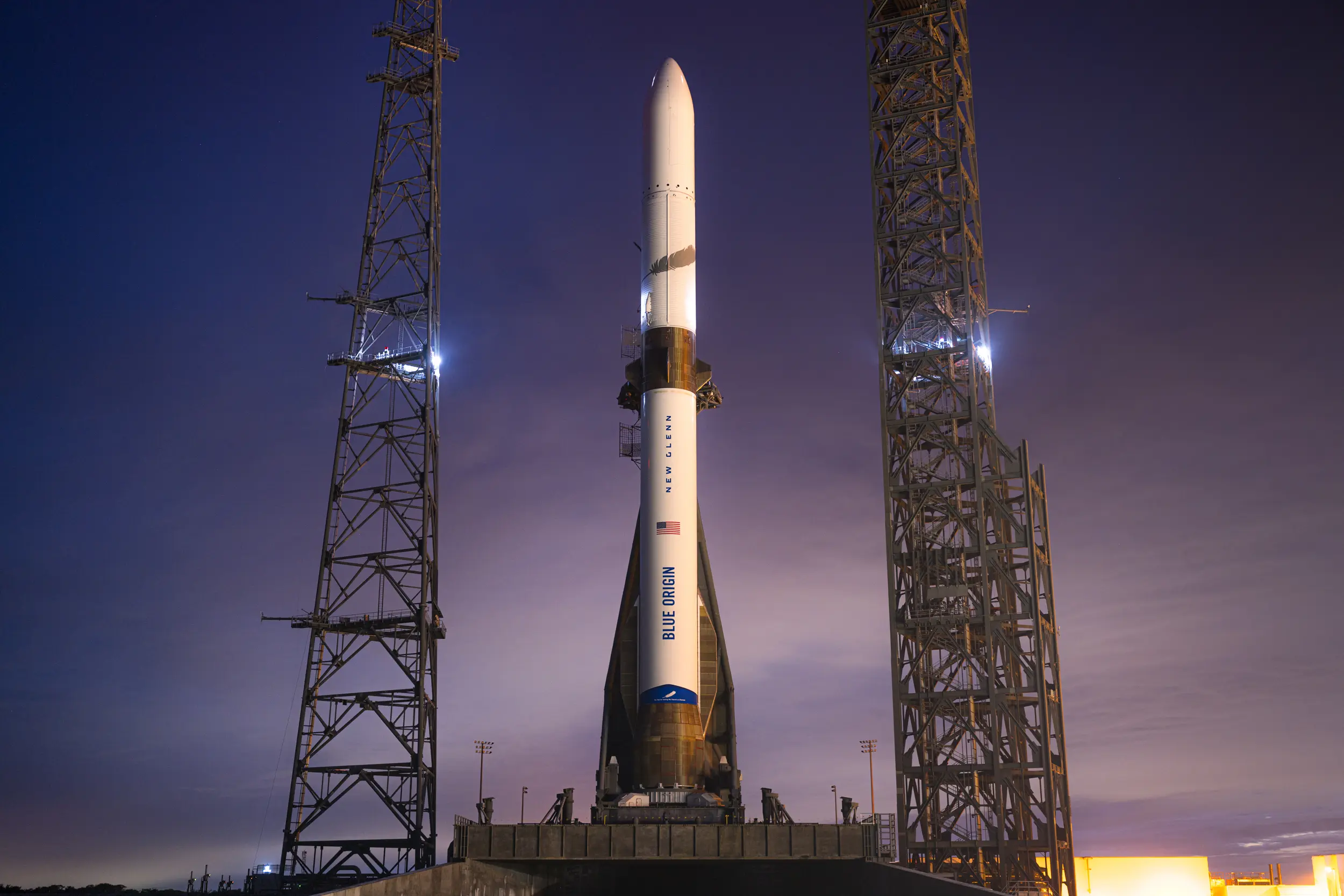
The centerpiece of Blue Origin’s progress in 2025 was the New Glenn heavy-lift launch vehicle. This is their first orbital flight, 25 years after the company was founded, and 10 years after Blue Origin became the first operator to propulsively land an operational, reusable rocket on Earth (New Shepard). After its long-awaited debut flight in January 2025, New Glenn logged two orbital missions with 100% success in delivering payloads to their intended orbits. On its second mission in November 2025, New Glenn not only injected NASA’s ESCAPADE twin spacecraft on an interplanetary trajectory toward Mars but also achieved a fully successful first-stage landing on the company’s recovery ship Jacklyn, marking the first time a New Glenn booster was recovered and re-ready for reuse. The landing profile, with a long hover beside the landing ship before actually moving over for landing, shows the vehicle used a very conservative flight plan, a design not relying on achieving extreme performance – it showed having plenty of spare performance.
While its inaugural flight deployed a Blue Ring Pathfinder payload into orbit, the second launch’s combination of deep-space delivery and booster reusability represented a watershed for Blue Origin’s competitiveness in the commercial launch market.
Next Step: New Glenn 9×4
Buoyed by the vehicle’s performance, Blue Origin announced plans to evolve the New Glenn family. The next version is a heavier-lift configuration with additional engines, for a total of 9 in the first stage and 4 in the second, thus named New Glenn 9×4. The extra performance means a higher payload mass capacity, supported by an even larger fairing: the current is already the widest fairing ever flown, at 7 m diameter, and the 9×4 version will reach 8.7 m. This variant aims to boost payload performance across low-Earth orbit (70 t), geostationary orbit (14 t direct to GEO, not to transfer orbit), and lunar injection (20 t) missions.
New Shepard: Prolific Flights and Human Spaceflight Milestones
In the suborbital arena, Blue Origin’s New Shepard continued to blaze a trail as one of the world’s most operationally mature crewed rocket systems. The program closed 2025 with 37 total flights, including the first all-female crewed mission and the first wheelchair user. The 7 crewed flights in 2025 carried a total of 42 astronauts.
Across its lifespan, New Shepard has now flown 92 individual astronauts (including repeat flyers), carrying scientists, educators, entrepreneurs, and space tourists above the Kármán line on short but transformative suborbital hops. New Shepard was also a crucial part in the development of New Glenn, particularly as a test platform for atmospheric flight dynamics and control systems of rockets that need to fly back down and land propulsively, and development and production of reliable liquid hydrogen engines (the engine for the second stage of New Glenn, the BE-3U, is a variant of the New Shepard’s BE-3).
The missions weren’t limited to passengers: several flights, including early 2025’s NS-29 research flight, helped simulate lunar gravity for payload experiments – a unique capability that supports NASA and commercial technology development.
A few snapshots from today's NS-37 mission! See more photos in our gallery: https://t.co/gpLbEqvCyC pic.twitter.com/bfSB14s3GN
— Blue Origin (@blueorigin) December 21, 2025
Blue Moon: Approaching the Lunar Surface
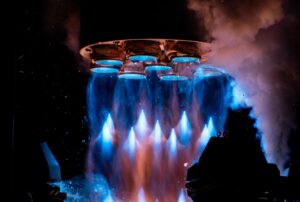
2025 also marked significant progress toward Blue Origin’s lunar ambitions. The company pushed forward the Blue Moon lander program, with its first cargo variant Mark 1 advancing through integration and pre-flight tests. Efforts included stacking operations and long-duration static firings of the BE-7 engine to validate the lander’s cryogenic propulsion system ahead of its planned first Moon landing attempt in 2026, which is expected to be the first reflight of a New Glenn first stage.
The uncrewed Mark 1 represents not just a technology demonstration but also a testbed for precision landing systems and lunar surface instrumentation – key precursors to the larger crewed Blue Moon Mark 2 vehicle slated for future NASA Artemis missions, which, as shown by the many recent failures of landers from many operators, are very difficult to implement successfully.
This week we completed direct field acoustic testing on our Blue Moon MK1 lunar lander, a major flight‑qualification milestone.
— Dave Limp (@davill) January 15, 2026
We surrounded the fully integrated lander with a ring of 34‑ft speaker towers to generate a near‑diffuse acoustic field, matching the New Glenn… pic.twitter.com/ngfSXw0s36
Blue Ring: From Pathfinder to Operational Platform
On the in-space systems front, Blue Ring – a high-delta-V orbital platform capable of transporting, hosting, and servicing payloads – made considerable strides in 2025. A Pathfinder version successfully rode on New Glenn’s first flight, enabling engineers to validate core systems in orbit.
Building on that success, Blue Origin announced forthcoming operational Blue Ring missions with integrated space-domain awareness sensors, aiming to demonstrate the spacecraft’s full utility across geostationary and deep space environments in the near future. Satellite servicing, in-space infrastructure and space domain awareness are nascent fields, with no current regular operations, expected to grow into key capabilities in the next few years.
Accelerate science. Expand discovery. Drastically improve affordability.
— Blue Origin (@blueorigin) January 15, 2026
Blue Ring is a science multiplier. By reducing costs through bulk buy options, it expands access across the inner solar system, from Earth science and planetary defense to lunar and Mars exploration, with… pic.twitter.com/enjJNrl6ws
Other Milestones and Industry Impact
Beyond flights and hardware, Blue Origin’s 2025 story included new national security launch work for New Glenn, with critical contracts awarded for future Department of Defense missions, signaling growing trust in the rocket for high-priority payloads. 2025 also saw: Blue Alchemist – their platform for performing ISRU (In-Situ Resource Utilization), in this case for separating oxygen from metals in simulated lunar regolith – pass its CDR (Critical Design Review); Blue Origin bringing in Tory Bruno (who just left as CEO of ULA), to head Blue Origin’s National Security Group; and a partnership with Optimum Technologies to add their sensors to Blue Ring, to make their first SDA platform.
Looking Ahead to 2026: A Pivotal Year of Expansion
- New Glenn: Following two successful New Glenn flights in 2025, both delivering their payloads with complete mission success and, on the second mission, a fully reusable booster recovery, Blue Origin has confirmed at least a third New Glenn launch planned for 2026. This mission will likely carry the Blue Moon Mark 1 Pathfinder lunar lander on a trajectory to the Moon’s south pole, marking the first dedicated lunar landing attempt by the company’s heavy-lift rocket. Beyond that, while there is no official Blue Origin manifest for the full year, several other launches have been mentioned as possible, including communication satellites for AST SpaceMobile and Amazon LEO (formerly known as Project Kuiper) a launch for the NRO (National Reconnaissance Office), and an operational Blue Ring flight.
- Blue Moon: Launched aboard New Glenn, this uncrewed lander will target a precision touchdown near the Moon’s south pole, validating key systems such as cryogenic propulsion, guidance, and surface communications that will underpin future lunar cargo and crewed missions. Success here would position Blue Origin as a major participant in NASA’s Commercial Lunar Payload Services (CLPS) ecosystem and as a future provider for Artemis campaign support. The concept of bringing Blue Moon’s crewed flight significantly forward, as the moon lander for the upcoming Artemis III mission, has been floated around in late 2025, but as of this writing, it is only speculative.
- New Shepard: Continued Suborbital Operations. On the suborbital side, New Shepard is expected to continue its brisk cadence of flights through 2026, carrying research payloads and private astronauts above the Kármán line, expanding access to space.
- Blue Ring and In-Orbit Services: Although Blue Ring’s first operational missions have yet to be fully detailed, Blue Origin has signaled that the orbital logistics platform will transition from Pathfinder status (as demonstrated in 2025) to customer-facing operational service as early as 2026. This would include hosting hosted payloads and space-domain awareness sensors in geostationary orbit, a key niche in commercial space infrastructure.
- Supporting National Security and Commercial Clients: Across 2026, Blue Origin’s launch services are expected to attract a broader slate of customers beyond NASA and tourism, including telecom constellations, national security space launches, and international payloads. While specific contract details and launch counts are still being finalized, the foundation laid in 2025, especially with New Glenn’s landing demonstrated, sets the stage for a significantly busier year ahead.
More info
A look back at 2025. The milestones, the mission, and the momentum. pic.twitter.com/chZ5iNJm9s
— Blue Origin (@blueorigin) December 31, 2025