Following the recent changes to the Artemis program, NASA leadership hosted the Ignition event on March 24, to present an extensive set of programmatic changes to implement the new National Space Policy. The briefings detailed a series of architectural realignments, acquisition strategy shifts, and new timelines across the agency’s space directorates (there was no mention to the aeronautics programs). The overarching strategy emphasizes near-term execution, repurposing of existing resources, and an acknowledgment of commercial market realities. The event, which the administrator had been referring to in recent weeks, hosted industry, academia and international partners, policy makers and foreign representatives, with 3 sessions livestreamed and private sessions on the next day.
Here is a breakdown of the major announcements and policy changes by sector.
Introduction: A New Fiscal and Operational Philosophy
- Budget reallocation: “No Top-Line Problem“: Administrator Isaacman repeatedly stated that NASA “does not suffer from a lack of funding”, indicating that new programs would come largely at the expense of existing programs being downsized or cancelled – besides some expectation of saving through better efficiency, such as reallocating contractors as civil servants. Operating with a $25 billion base budget and a $10 billion plus-up, the agency would prioritize repurposing existing, paid-for assets (such as the VIPER rover, Gateway parts, and nuclear reactor technologies) rather than requesting vast new funding lines.
- Ending Legacy Extensions: NASA will minimize funding for legacy missions to free up resources for the Artemis and commercial mandates. This is a sharp shift from the traditional practice of maximizing mission efficiency by extending them for as long as the hardware was operational – often with somewhat underfunded operations.
Artemis: Pausing Gateway and the “Race to the Surface”
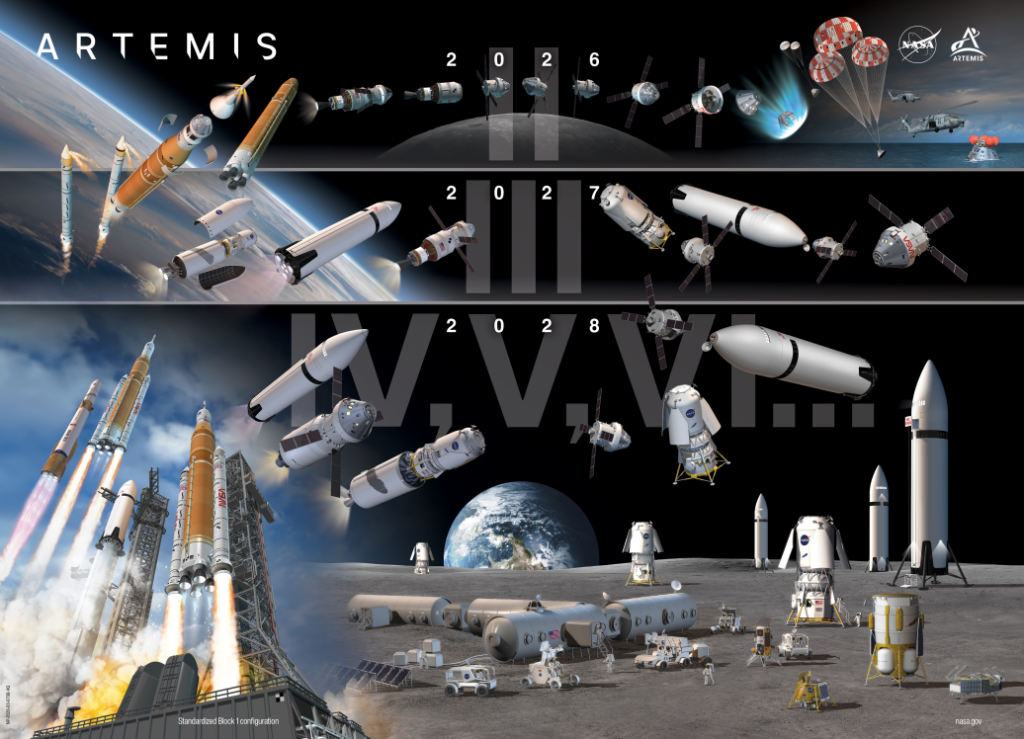
- The Gateway Pause: NASA is officially pivoting away from the orbiting Lunar Gateway. Citing that the program had not passed the “point of no return” and that its planned habitat modules were facing significant technical issues, NASA will repurpose some of them directly for lunar surface use. Associate Administrator Amit Kshatriya noted that building on the surface allows for better compartmentalization of risk between landed assets compared to an integrated space station.
- Relaxing NRHO Requirements: NASA is dropping the strict requirement for the Human Landing System (HLS) to utilize a Near-Rectilinear Halo Orbit (NRHO), which is where Gateway would be. Providers may now utilize lower lunar orbits, granting greater landing mass margins and enabling safer, faster abort capabilities back to Orion.
- VIPER’s Ride Secured: Administrator Isaacman previously mentioned repurposing the fully built VIPER rover, and the science fact sheets revealed exactly how it will get to the Moon. NASA has awarded Blue Origin a CLPS task order to deliver VIPER to the lunar South Pole.
- Artemis III EVA Suit Testing: The updated Artemis III mission profile is not just a test of the Human Landing System (HLS), this 2027 Earth-orbit risk-reduction flight will also serve as a critical test for the new extravehicular activity (EVA) spacesuits from Axiom, before committing them to the lunar surface.
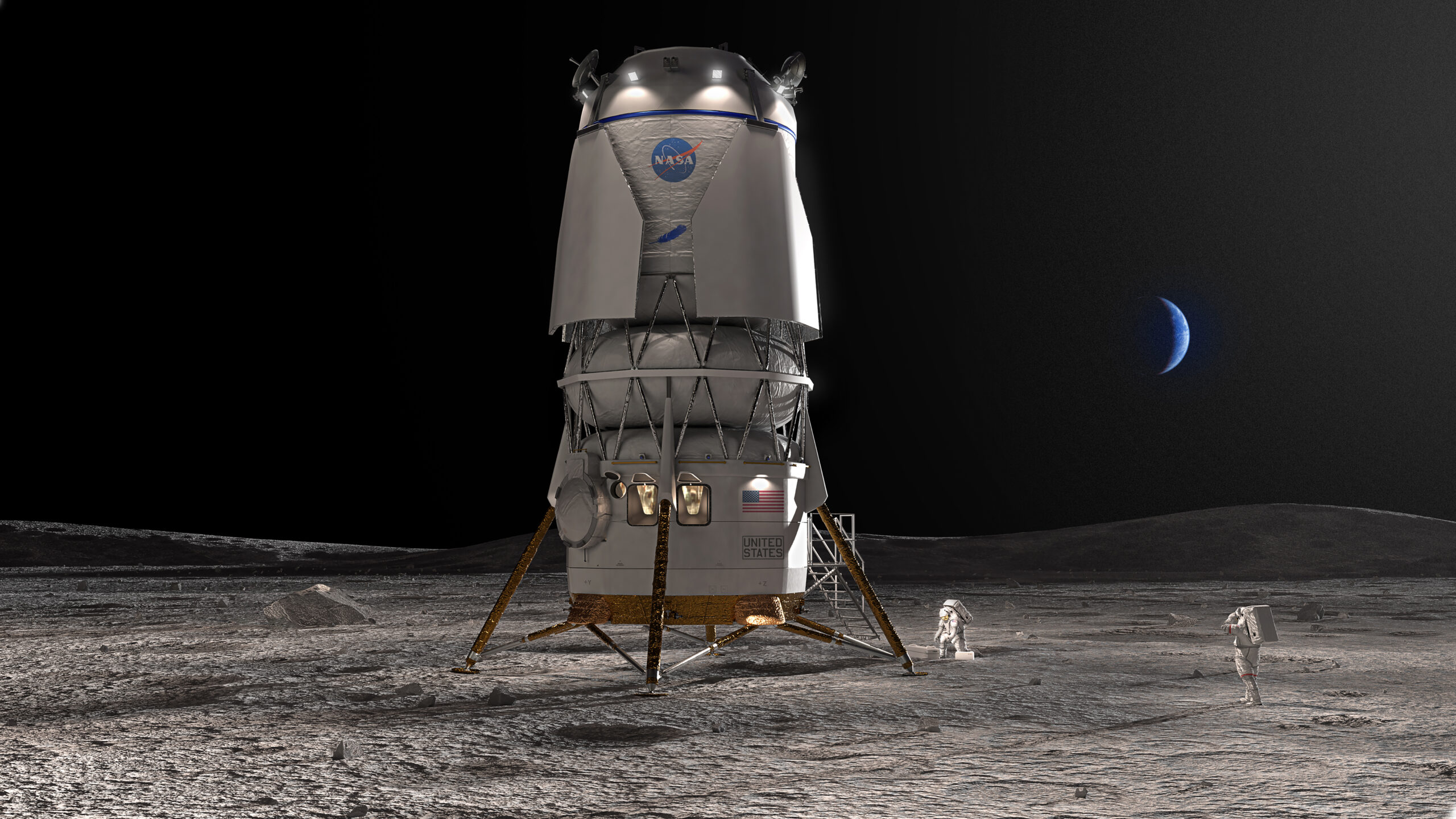
- The Artemis IV Race to the Surface: For the first time, the question that arose with the Artemis changes announced in March has been answered: The first crewed landing, scheduled for Artemis IV in 2028, will be flown by whichever HLS provider is ready first, creating a direct competition between SpaceX and Blue Origin, informed by the results of the Artemis 3 flight. Artemis V, also listed for 2028, has its mission profile and hardware even more undefined as of now.
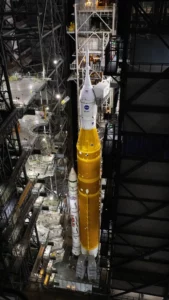
- SLS Standardization: To support a higher launch cadence, the SLS architecture is being standardized around the Centaur 5 upper stage, as identified earlier in the month by a JOFOC posted in SAM.gov. While not yet certain, there is the possibility its debut will be in Artemis V, preserving the final Interim Cryogenic Propulsion Stage (ICPS), originally scheduled for Artemis III, to the Artemis IV lunar landing, with Artemis III flying without a second stage.
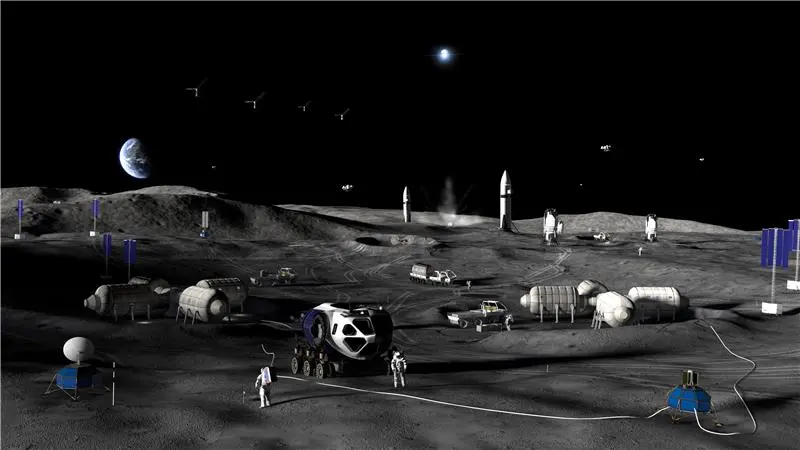
- Three-Phase Moon Base: Carlos Garcia Galan, who serves as the Moon Base Program Executive, outlined a phased approach to a permanent surface base, backed by $20 billion: Phase 1 (robotic experimentation, now–2029), Phase 2 (primary infrastructure, 2029–2032), and Phase 3 (habitation, 2032-).
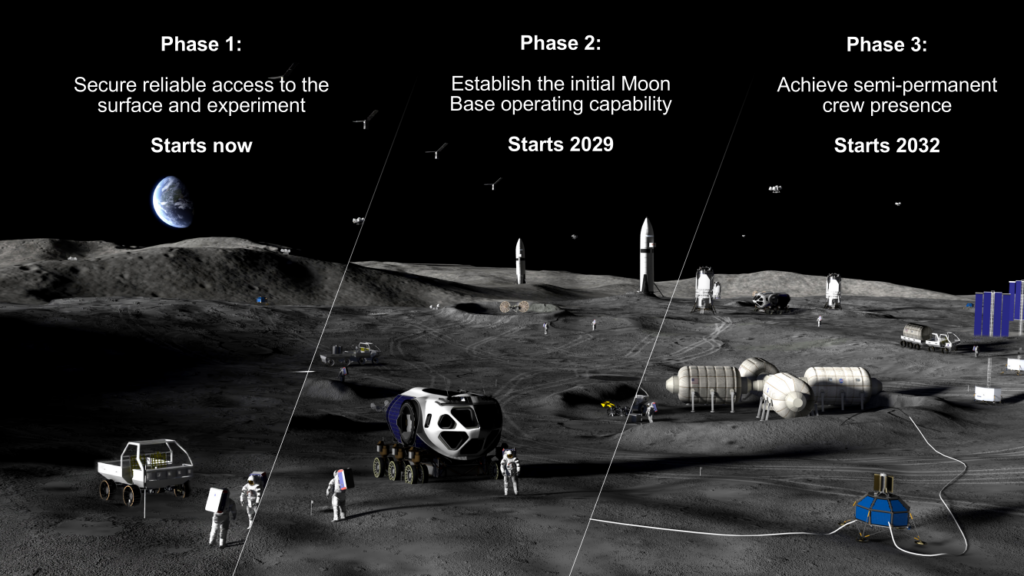
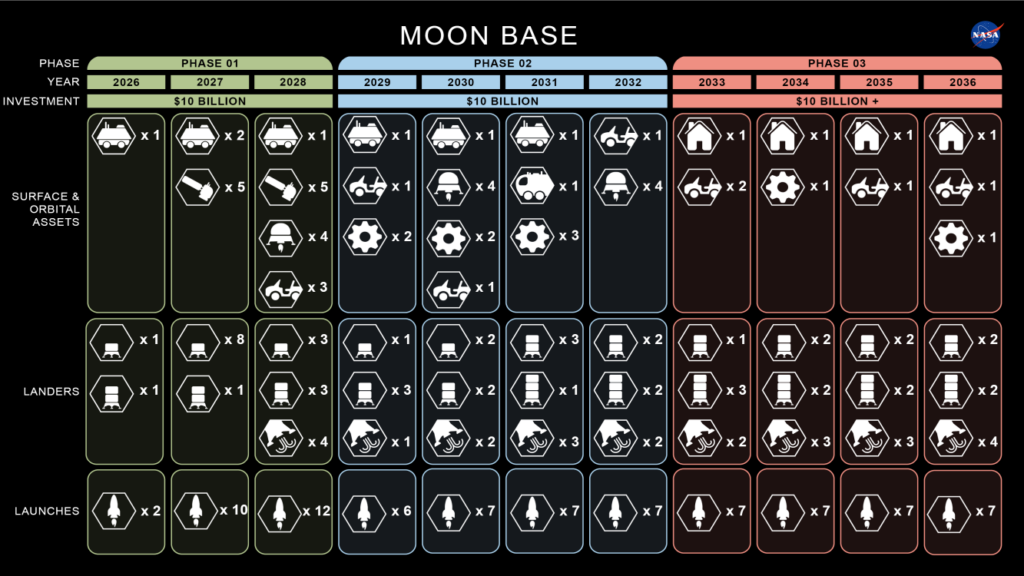
- Aggressive Phase 1 Logistics: Targets include 25 launches, 21 landings, and 4 tons of payload delivered to the surface by 2028, supported by two new lunar orbital communication and navigation constellations.
- Scaling Logistics for Phases 2 and 3: While Phase 1 focuses on early experimentation, the newly released metrics for the later phases outline a massive logistical escalation. During Phase 2 (Early Habitation), NASA plans to deliver up to 60 tons of cargo through up to 24 landings, utilizing a mix of low, medium, and heavy cargo-class landers to build out the primary surface infrastructure. By Phase 3 (Sustained Human Presence), the logistical requirement scales to delivering up to 38 tons of cargo per year. This sustained yearly cadence is designed to support permanent habitats, power stations, and major science outposts, relying heavily on the expected availability of low-cost, reusable heavy-lift launch capabilities.
- Massive CLPS Expansion & LTV Pivot: The Commercial Lunar Payload Services (CLPS) program is scaling up to target 30 robotic landings starting in 2027 (including a newly announced 5th award for Intuitive Machines). Concurrently, NASA is pivoting from a single 2030 rover to procuring simpler, incrementally upgraded Lunar Terrain Vehicles.
- Moonfall Lunar Drones & Cargo Return: NASA will deploy independent propulsive drones to scout shadowed craters, called Moonfall, based on JPL/AeroVironment’s Skyfall Mars helicopter architecture (replacing the propellers with thrusters) and establish a two-way logistics chain capable of returning 500 kg of lunar mass to Earth.
- Embedded NASA SMEs: As previously, Isaacman has indicated a shift from oversight to a more active role, with NASA embedding its engineers directly into commercial supply chains to clear bottlenecks and is prepared to bring component manufacturing in-house if necessary. Which is a marked shift from the previous hands-off approach to simply contracting the services from industry, such as the HLS (SpaceX and Blue Origin) and Artemis suit (Axiom) contracts. Again, what was never addressed is how much extra cost this represents to the agency, and where those funds would come from – every NASA employee and contractor is paid by work-hour on by each project they work on. Thus, with this new task being carried out by the NASA workforce, even if the HLS or Axiom suit gets delivered “on budget” (referring to the contracted fixed price), they would still be overbudget for NASA, by an amount that can easily exceed the budget of entire missions.
- SLS as a Commercial Option: SLS is sure to be used up to Artemis V. For VI and beyond, the vehicle is explicitly yet to be defined, with a “desire to move to a commercial option” expressed. However, expecting either SpaceX or Blue Origin to come up with a crew-rated vehicle able to replace SLS/Orion in such a short time would be a huge programmatic risk. When inquired about this, the response was that to ensure a safe, crew-rated option remains available, legacy contractors will be allowed to bid existing SLS/Orion hardware as a commercial service. This new avenue would effectively mean a hybrid model, with the expensive and lengthy vehicle development having been funded by NASA in the traditional cost-plus model, to then become an operational product to be offered by the legacy contractors as a fixed-price transportation service, mostly just reflying the standardized vehicle developed in the current cost-plus program.
Commercial LEO: A Stark Admission and the “ISS-Anchored” Alternative
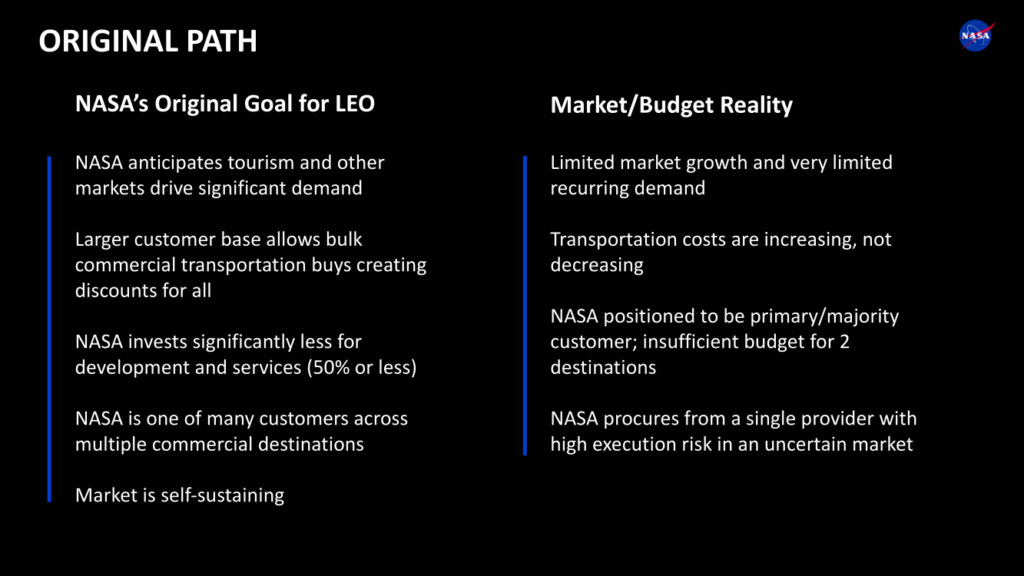
- Commitment to continued presence in LEO: It was repeatedly stated that NASA is committed to maintaining continuous human presence in LEO beyond the ISS, which is reaching the end of its life, and that “doing nothing is not an option”.
- The Context of ISS Operations: To underscore exactly why a commercial replacement is so difficult, the fact sheets provided stark historical data. The ISS required 37 shuttle flights, 160 spacewalks, and over $100 billion to build – and has required more than 110 corrective spacewalks just to stay operational. NASA warned that any new commercial station will face these exact same grueling operational challenges
- The Failure of LEO Market Projections: Dana Weigel, the LEO Program Manager, delivered a sobering reality check regarding the Commercial LEO Destinations program. Acknowledging that market research has perpetually placed a self-sustaining LEO economy “10 to 15 years away,” they noted that transportation costs are actually increasing, and human spaceflight remains too expensive to survive without heavy government subsidies. Thus, the expected new commercial replacements for the ISS have not been progressing enough to be in place by the time of the nominal ISS retirement in 2030.
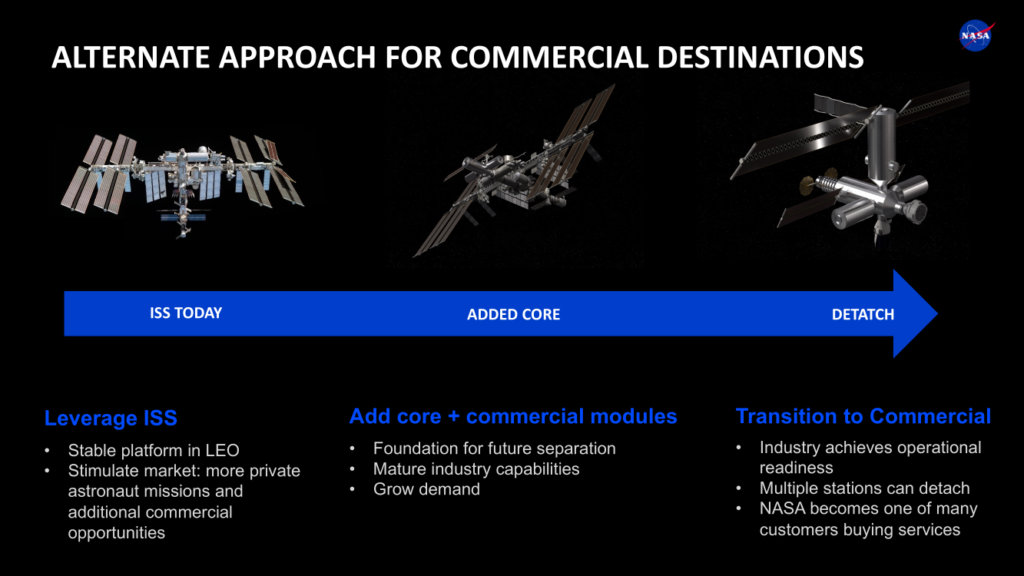
- The ISS-Anchored Solution: Unable to shoulder the cost and execution risk of procuring from a single commercial provider in an uncertain market, an alternative was proposed. They are exploring the procurement of a government-owned Core Module to attach to the ISS. Commercial modules would dock to this core to mature their capabilities using the ISS as a safe haven before eventually detaching into free-flight.
- Keeping Options Open: Requests for Information (RFIs) were released immediately for both the original standalone commercial station pathway and the new ISS-anchored approach, leaving the final architectural decision dependent on industry feedback.
- Expanding Private Astronaut Missions (PAMs): To stimulate the market, NASA will be doubling PAMs to two per year, allowing commercial companies to sell the Commander seat, and considering purchasing commercial seats for its own astronauts. This left some unanswered questions: 1) Would the NASA astronauts fly in PAMs in addition to the regular crew rotation, already contracted to SpaceX’s Dragon and Boeing’s Starliner, or in replacement of them flying in Dragon/Starliner? 2) With the acknowledgement that the current $250 M / year is insufficient to support the replacement station, where would the funding come to pay for astronauts to fly in PAMs? 3) Will this end up just replacing the currently free NASA astronaut rides as PAM Commanders with paying industry to fly them?
- Joint Missions and Microgravity Prizes: Beyond expanding PAMs , NASA is considering joint commercial-NASA crew missions. Furthermore, to help ignite a true orbital economy, the agency will leverage its statutory prize authority to fund market-driven awards for breakthroughs in microgravity manufacturing.
Science: Universal Ride-Shares, Repackaging, and Private Flagships(?)
- A Universal “Call for Science”: NASA is supporting a “Science as a Service (SaaS)” model, mandating that science payloads piggyback on virtually every infrastructure and technology demonstration flight heading to the Moon and Mars to maximize payload volume efficiency, and looking for paying for data from commercial providers instead of flying NASA payloads.
- The Commercial Rescue of Hubble: Asked about the decaying orbit of the Hubble Space Telescope due to solar maximum drag, for the first time there was an acknowledgement that the currently contracted commercial mission with the startup Katalyst, to reboost the Swift telescope, is a technology demonstration for a possible future Hubble boost.
- The Falcon Fleet (Realigning AOS): Replacing the canceled monolithic Atmosphere Observing System (AOS) flagship, Falcon (Fleet for the Atmosphere Linking Commercial Observations with NASA) represents a distributed, constellation-based approach to studying cloud coverage and atmospheric dynamics. Instead of building one massive satellite, NASA will use a fleet architecture that links existing venture-class missions (like INCUS and PolSIR) with commercial hardware. To execute this, NASA released an RFI exploring commercial approaches to procure a commercially owned and operated microwave radiometer capability. This commercial asset will fly in formation with the NASA Earth observation constellation to increase operational efficiency, reduce development time, and maintain crucial climate data continuity.
- The EAGLE Mission (Realigning SBG): The newly announced EAGLE (Explorer for Artemis Geology Lunar and Earth) program focuses on the high-resolution mapping of critical minerals and surface compositions. Programmatically, this serves to effectively rescue and maintain the hyperspectral imaging capabilities of the recently canceled Surface, Biology and Geology (SBG) flagship mission. By tying the technology’s development directly to the Artemis program’s need for advanced lunar geology tools, NASA is securing vital Earth observation science by presenting it under a new, deep-space exploration framework. A news article published the next day quoted Karen St. Germain, NASA’s earth science chief, that EAGLE and Falcon are not simply rebadged SBG and AOS.
- Firming Up Near-Term Planetary Missions: While establishing the new Science as a Service model, Nicola Fox also reaffirmed aggressive near-term launch targets for several dedicated robotic science missions. The NEO Surveyor planetary defense telescope is officially on track for a 2027 launch to detect and characterize potentially hazardous asteroids and comets. Additionally, the ESCAPADE mission is scheduled to arrive at Mars late next year to study the planet’s space weather environment. Finally, 2028 will see a major push in deep space exploration, with the launch of both the nuclear-powered Dragonfly rotorcraft to Saturn’s moon Titan and the European Space Agency’s Rosalind Franklin Rover to Mars.
- Advancing HWO and DAVINCI: While heavily focused on the SaaS model, NASA is still advancing its long-term flagships. The agency recently selected proposals from eight U.S. companies to advance technologies for the Habitable Worlds Observatory (HWO). Additionally, NASA continues the formulation of DAVINCI, the first 21st-century mission designed to plunge through Venus’s atmosphere.
- LuSEE-Night on Firefly: Before the massive scale-up of lunar logistics, an immediate CLPS delivery is scheduled for later this year. Firefly Aerospace will deliver the LuSEE-Night instrument (a joint NASA/DOE project) to the far side of the Moon to conduct observations regarding the early history of the universe.
- The Roman Space Telescope Defies Procurement Trends: Providing a rare bright spot in agency development timelines, the Nancy Grace Roman Space Telescope is now fully assembled and has passed its final major prelaunch tests, currently running ahead of schedule. During the briefings, Administrator Isaacman specifically highlighted Roman as the agency’s only major program currently operating both on time and under budget, keeping it on track for a launch as soon as this fall.
- Soliciting Philanthropy for Deep Space: Facing budget constraints, the Science Mission Directorate explicitly invited private organizations and philanthropists fund priority flagship missions, specifically identifying a Uranus mission (one of the priorities of the last Decadal Survey) and an Apophis planetary defense interceptor. With the RFIs being released now, it is still unclear if there will be any uptake. Industry, private entities, NGOs and non-federal governments have expressed interest in Earth, planetary and Astronomy missions recently, such as the Earth Fire Alliance, Carbon Mapper, Schmidt Sciences (including the Eric and Wendy Schmidt Observatory System, a comprehensive set of ground- and space-based telescopes), and Rocket Lab, Blue Origin and Relativity Space (the latter now with Eric Schmidt as CEO and controlling partner) having announced intent on planetary missions.
Nuclear Power: Announcing SR-1 Freedom
- Confronting a “History of Failure”: the Administrator and the Space Reactor Office Program Executive Steve Sinor started by presenting space nuclear power programs as a necessity for higher power in ambients of limited sunlight – lunar night, Mars surface (due to the weak sunlight sometimes interrupted by dust storms, which have ended several mission), and beyond Jupiter -, and higher power needs (electric propulsion, ground-penetrating radar, extended life support). Then the past programs were framed as a ” $20 billion history of failures”, attributed to scope overreach (such as the megawatt-class JIMO program), timeline mismatches, and fragmented multi-agency leadership.
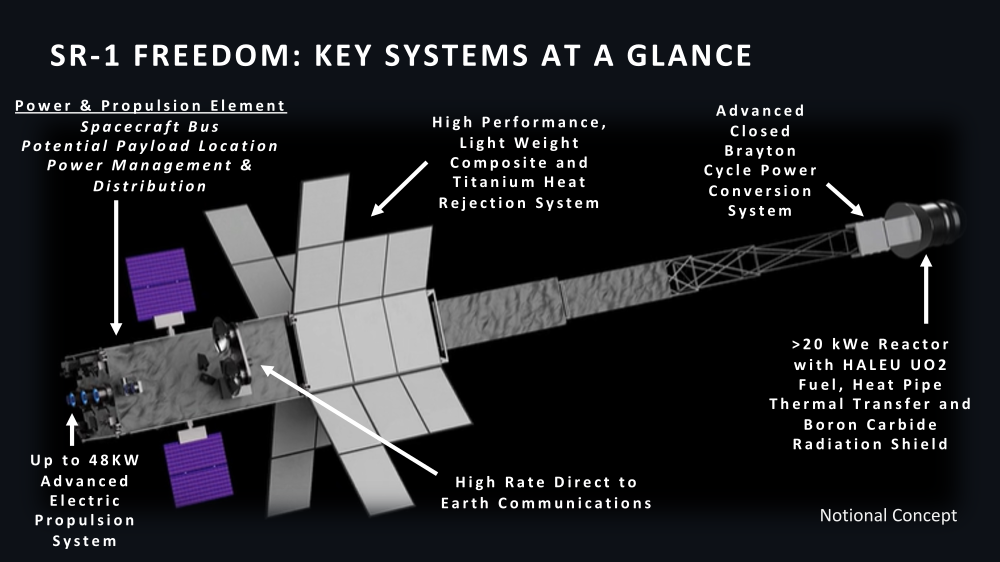
- SR-1 Freedom Mars Mission: To finally get to an operational nuclear powered mission, they announced, launching in 2028, Space Reactor-1 (SR-1) Freedom, as a “right-sized”, 20-kilowatt Nuclear Electric Propulsion (NEP) demonstrator, framed as the first step in establishing a high-efficiency logistics chain for moving heavy cargo through the solar system. As opposed to traditional space usage of nuclear power (solid-state, low power, by RTGs), the reactor would use induced fission in a closed loop, with HALEU (High-Assay Low-Enriched Uranium) fuel.
- Repurposing the Gateway PPE: In yet another major programmatic change, the spacecraft bus for SR-1 Freedom will be the Power and Propulsion Element (PPE) originally contracted for the Lunar Gateway – itself, originally developed for the Asteroid Redirect Mission (ARM), then moved to Gateway when ARM was cancelled. This provides direct-to-Earth communications and 48kW electric thrusters, to significantly reduce development time. It is worth noting that the PPE also has traditional chemical bi-propellant propulsion, and that the SR-1 mission profile was designed to fly to Mars as usual, relying only on the launch vehicle and PPE’s chemical propulsion, with the typical travel time of one year. Thus, the nuclear-powered propulsion would be just a technology demonstrator, and any significant delta-V would be a bonus – if it works really well, possibly enabling the vehicle to continue for an extended mission after delivering its payload to Mars.
- Tri-Party Industrial Campaign: The aggressive timeline is supported by isolating responsibilities: the Department of Energy handles the HALEU fuel, private industry builds the reactor and radiators, and NASA integrates and flies the systems.
- Skyfall Helicopter Deployment: SR-1 will deliver the Skyfall payload to Mars – a team of three Ingenuity-class helicopters, as developed by JPL and AeroVironment, Inc. In a first-of-its-kind maneuver, they will deploy mid-air from the hypersonic entry capsule to immediately begin flying, not having a lander vehicle, similarly to how Dragonfly will start operating on Titan. Their mission would be scouting future landing sites and, possibly, subsurface ice, if their mass and power can support a ground-penetrating Radar (still unclear if the Radar would be achievable)
- Lunar Reactor 1 (LR1): The SR-1 flight heritage and regulatory precedent will be directly applied to the Moon with LR1, targeted for 2030, which will adapt the 20kW fission technology to power the Phase 2 Moon Base.
- Technological legacy: While there were repeated statements that the past $20B spent in space nuclear reactors that never flew were “failures”, SR-1, future programs were characterized as enabled by use of existing designs and prototypes enabling reaching flight readiness in a very short time. Which seems to be ignoring that such designs and prototypes only exist due, at least in part, to the $20B spent in these “past failures”.
With so many simultaneous program changes, many depending on responses to RFIs and future RFPs, amidst deep workforce changes, followed two weeks later by a skinny FY27 budget with a 20% overall cut to NASA, the future of human exploration and science programs is still very open, with lots of uncertainty.
More info
Our article on the Artemis changes
The official Ignition site
https://www.nasa.gov/ignition/
RFIs released with the event
| Solicitation / RFI Title | Release Date | Target Program / Directorate | Core Objective |
|---|---|---|---|
| Astrophysics SMEX Community Announcement | March 23, 2026 | Science Mission Directorate (Astrophysics) | A precursor announcement detailing a new, expedited one-step proposal process for the upcoming Small Explorer (SMEX) astrophysics mission, aimed at reducing the time to launch and leveling the playing field for smaller institutions. |
| “Science as a Service” (SaaS) RFI | March 24, 2026 | Science Mission Directorate | Seeking input on commercial business cases where NASA investments (validation, flight access) reduce risk. Aims to identify commercialization opportunities for instruments, data analytics, and payload hosting across future infrastructure missions. |
| Near-Term Lunar/Mars Payload RFI | March 24, 2026 | SMD / CLPS & Exploration | A direct call for flight-ready (near- and medium-term) science and technology payloads to fill the massive volume available on the newly accelerated cadence of lunar CLPS landers and upcoming Mars infrastructure missions (like SR-1). |
| Falcon Fleet Microwave Radiometer RFI | March 24, 2026 | SMD (Earth Science) | Soliciting industry interest for commercially owned and operated microwave radiometer capabilities to fly in formation with NASA’s upcoming “Falcon” Earth observation fleet, exploring data buys and co-funded tech development. |
| LEO Destinations: Architecture RFI | March 25, 2026 | LEO Operations | Gathering industry feedback, market outlooks, and structural concepts for the ISS transition. It explicitly seeks input on both the original standalone commercial station plan and the newly proposed “ISS-Anchored” Core Module approach. |
| LEO Destinations: Transportation RFI | March 25, 2026 | LEO Operations | Released alongside the Architecture RFI, this document specifically focuses on gathering industry feedback regarding the logistics, costs, and constraints of crew and cargo transportation required to sustain future commercial LEO destinations. |